Taxonomies and Their Tools: Key Elements for Understanding, Adoption, and Applicability
Vanessa Caldas, Adriana Bazán Fuster, y Sarahí Malanche.

Sustainable finance taxonomies are designed to direct and increase financial flows toward sustainable economic activities. This is achieved through generating objective classifications grounded in scientific criteria and by promoting greater transparency in the allocation and use of financial resources—both public and private.
However, despite the publication and implementation of over 30 taxonomieslworldwide, there is still no documented evidence confirming that taxonomies are indeed increasing financial flows in the global market. This absence of evidence highlights persistent barriers to taxonomy adoption and application. Challenges underscore the voluntary nature of most taxonomies, a lack of technical understanding among potential users and limited public information and other resources available to facilitate implementation.
In this context, creating tools that bridge and support taxonomies and their end users is crucial. These tools transform and translate the theoretical framework into practical, actionable and more accessible components to enable the effective and systematic use of taxonomies in financial decision-making for sustainable finance.
Measuring Taxonomy Applicability to Promote the Alignment of Financial Flows
Green or sustainable taxonomies allow market players to identify projects and assets that meet environmental, social and sustainability criteria. By providing clear and standardized definitions, taxonomies facilitate tracking, traceability and verification an investments’ impact, as well as its alignment with the environmental objectives defined by each country. Likewise, taxonomies’ uses extend to the public sector, where they serve as strategic instruments to improve budget planning and allocation, strengthen public policies and channel financial flows towards climate and environmental goals, specifically those framed by international commitments.
Nevertheless, these expected benefits have yet to translate into clear measurements of impact on mobilizing financial resources. As a result, a fundamental question arises: If multiple taxonomies have been developed and published in recent years, why is there still no empirical evidence of their impact?
A significant part of the answer lies in the limited adoption and effective implementation of taxonomies by market players. For example, the IDB (2024) identified critical challenges for the implementation of Mexico's Sustainable Finance Taxonomy (TSM) :
- The need for tailored training and capacity building strategies for different actors
- The transition from a voluntary framework to a regulatory/mandatory framework
- The accessibility and understanding of the information required to assess the alignment of economic activities with the established criteria.
These obstacles are not unique to this Mexico example and are likely spread across other jurisdictions in similar stages of taxonomy implementation.
In this regard, what actions can jurisdictions or countries take to overcome these challenges and achieve effective taxonomy adoption? Evidence shows that several countries are building support tools that serve as a critical nexus between taxonomies and their practical application. These tools help:
- Strengthen key users’ (investors, banks, companies, public institutions, etc.) technical and institutional capacities
- Facilitate inter-institutional coordination among relevant ministries, financial regulators and the private sector
- Generate application guidelines or manuals for taxonomy adoption
- Establish incentives for adoption and use
- Promote interoperability with other taxonomies
- Integrate taxonomies with other public policy instruments linked to green, climate and sustainable finance mobilization.
Support Tools: Key Components for Ensuring Taxonomy Use and Implementation
Tools can be grouped into three categories based on their primary purpose: socialization, usage and implementation.This classification highlights how tools facilitate understanding, adoption and the effective application of taxonomies across different user groups.
- Socialization: Tools aimed at raising awareness and disseminating the concept of taxonomies, communicating their structural elements, objectives and benefits. They inform the general public and future users about the taxonomy development process and its future application.
- Usage: Tools designed to facilitate and optimize the practical application of taxonomies, improving the user experience for financial sector actors, companies or public entities.
- Implementation: Tools intended to enable the formal adoption of taxonomies within national institutional, regulatory and policy frameworks, as well as within financial institutions.
Insights into International Evidence
To date, various tools developed by jurisdictions during their taxonomy development and implementation processes have been identified. These tools span the three functional categories, sometimes serving cross-cutting roles (i.e., contributing to multiple objectives simultaneously).
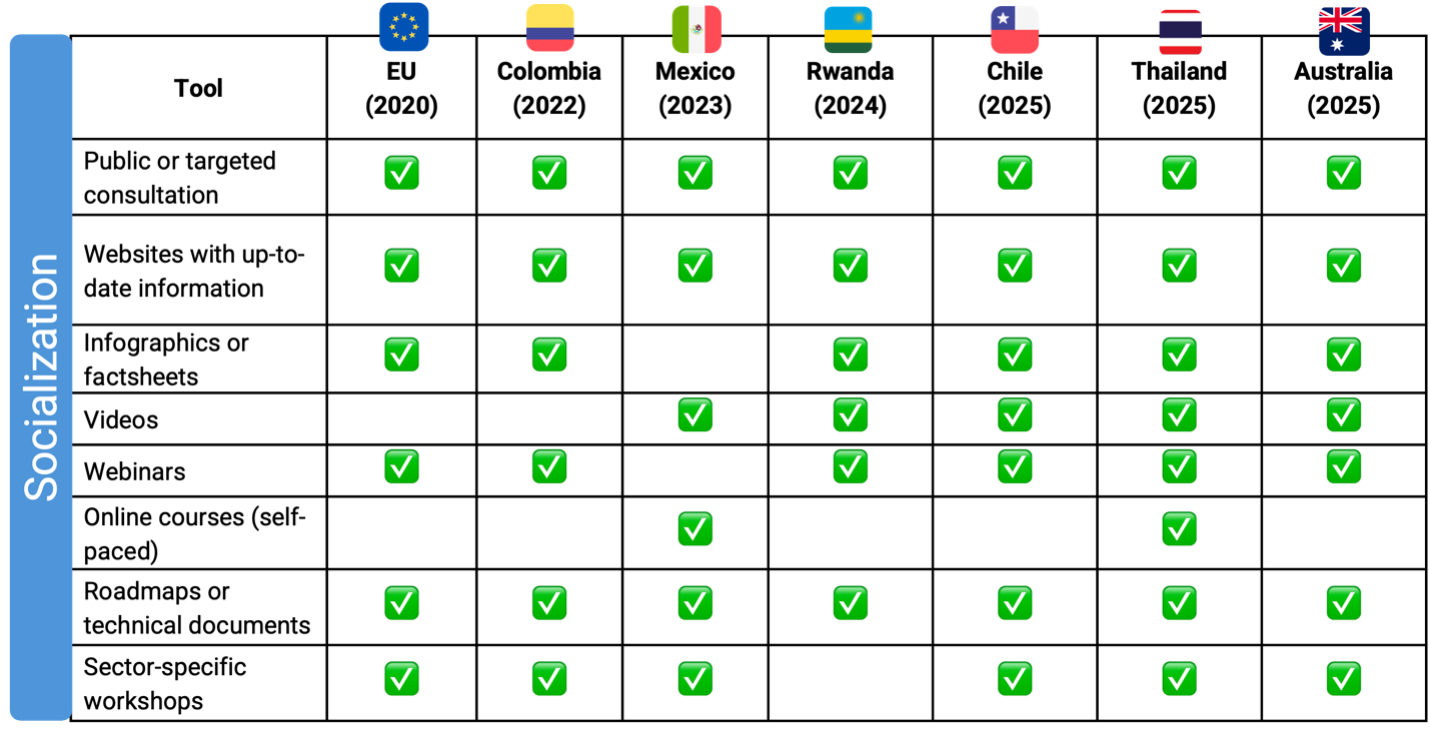
Examples of socialization tools: . are An Infographic in English y Spanish for Chile’s new taxonomy, the infographics from Thailand,and, Rwanda,and, Singaporeand, Australia,; the taxonomies websites from the European Union, Chile, Mexico, Colombia,, Rwanda,, Thailand,, Paraguay,, South Africa,, Australia,, New Zealand;the explanatory videos of the taxonomies used in Chile, Mexico, Thailand,; the online course (self-directed) featuring Mexico’s taxonomy and the seminar for the taxonomy in Thailand..
Among the most common usage tools are the consolidated tables of taxonomies for better navigation of technical criteria, such as the EU Taxonomy Compass (Brújula de la Taxonomía de la Unión Europea), el cuadro consolidado de las taxonomías de Colombia,, Thailand, Georgiaand Mexico. Furthermore, countries are using platforms and Excel-based tools to evaluate how well economic activities align with taxonomies—for example, the European Union Taxonomy Calculator or the tool used to assess alignment with Mexico’s Sustainable Taxonomy (TSM).
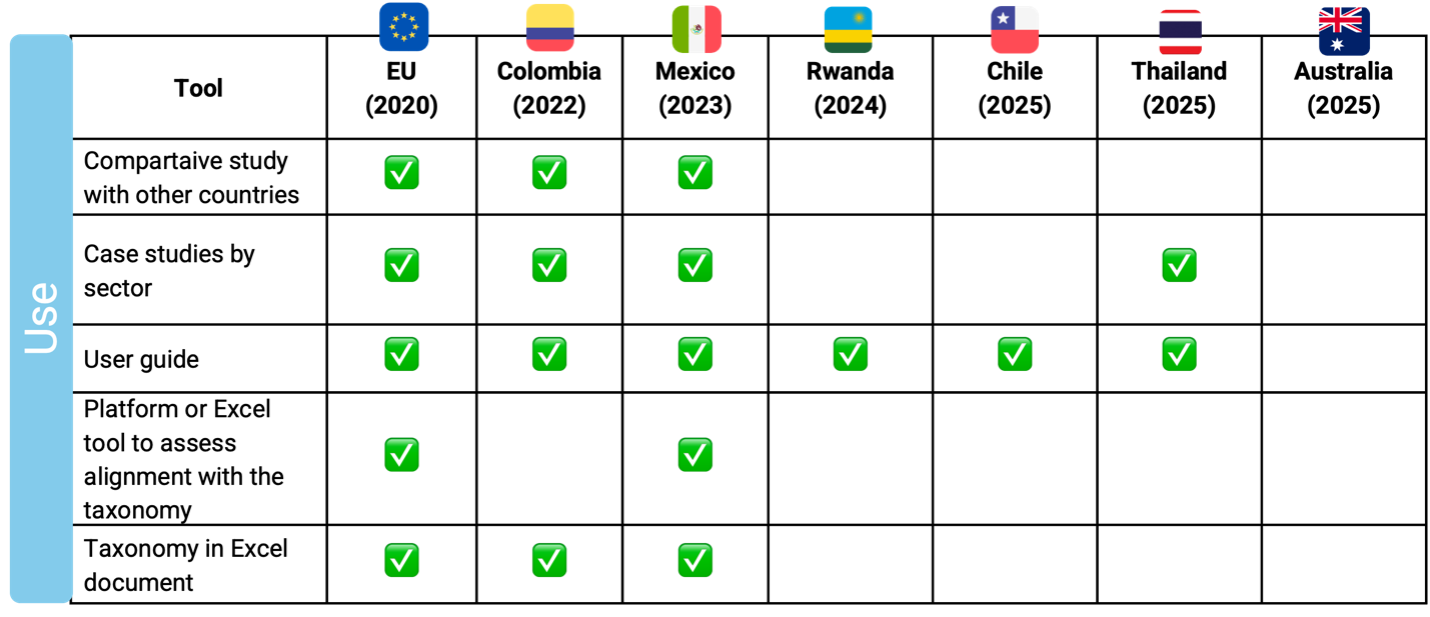
Other usage tools include the user guides for users, including the Thailand Taxonomy Usability Guide and accompanying infographic.Also noteworthy is the Rwanda Green Taxonomy User Guide found in Chapter 06 of the Taxonomy document, as well as the Taxonomy of Environmentally Sustainable Economic Activities of Chile (T-MAS) user guide which is found in chapter 03 of the document. Likewise the user guide to navigate the European Union taxonomy,the general implementation guide and the guide for banks in the management of green loans of the Colombian taxonomy are excellent resources for taxonomy users.
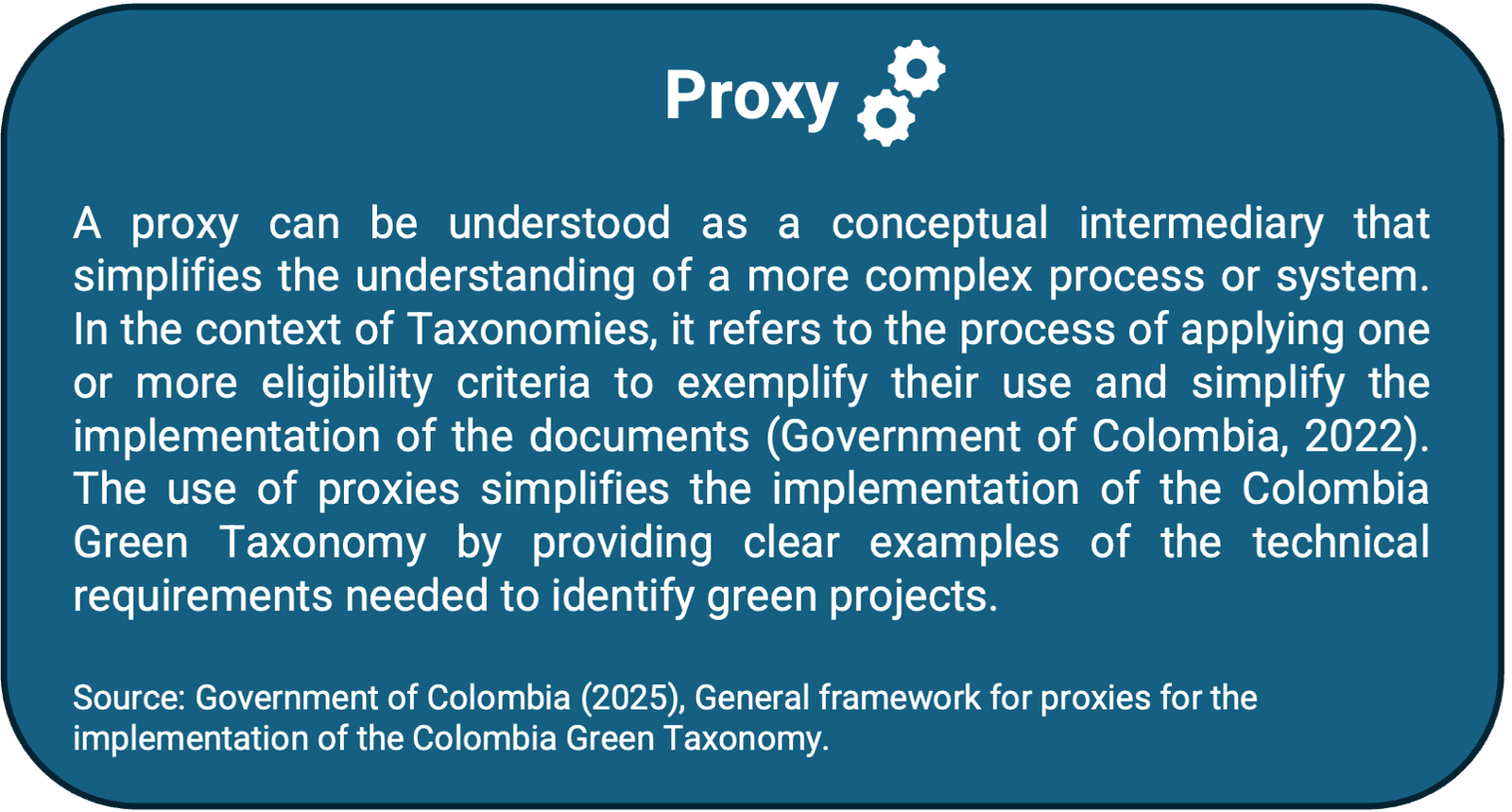
The development of 18 proxies to verify compliance with substantial contribution criteria in transport, to verify compliance with substantial contribution criteria in transport, water and land use activities under the Colombian taxonomy—particularly focused on small and medium-sized producers—represents one of the most advanced support tools available.
On the other hand, examples of implementation tools that are in the public domain are still emerging. For instance, these can be discovered in the results of pilot exercises for the taxonomies in Colombia, Mexico, South Africa,and the regulatory roadmap associated with TSM and other ESG aspects that frame the adoption and compliance of TSM in the investment and risk management processes of retirement savings systems. Within the framework of this roadmap, the circular notice on insurance and bonds was was published to integrate ESG criteria as well as the application of the TSM to guide the investment decisions of these market players. This also included the framework for the issuance of sustainable bonds by Nacional Financiera (NAFIN) aligned with the TSM.
From Design to Action: Tools that Transform Taxonomy Impact
A taxonomy alone does not drive transformation. To achieve one of its core objectives—channeling financial flows toward sustainable activities—it must be accompanied by tools that translate its technical design into concrete actions that can be used by the public, financial and industrial (productive) sectors. Global research and trends show that:
- - Socialization tools build understanding and legitimacy.
- - Usage tools enable day-to-day application.
- - Implementation tools ensure institutional and regulatory integration.
These tools are essential not only for the successful adoption of taxonomies in both the short and long term, but also for unlocking their transformative potential—by aligning financial flows with national and international climate goals and improving transparency around the allocation and impact of climate finance.
Call to Action
The Center for Clean Air Policy (CCAP) and Planisphera urge stakeholders to invest in developing context-specific tools that prioritize user needs. Only with the right tools can taxonomies evolve into effective drivers of sustainable finance.
Are you working on building or implementing a taxonomy? Don’t overlook the importance of a tailored Taxonomy Toolbox. Share your experience in the comments below—we’d love to hear about your taxonomy journey!